STRATEGY
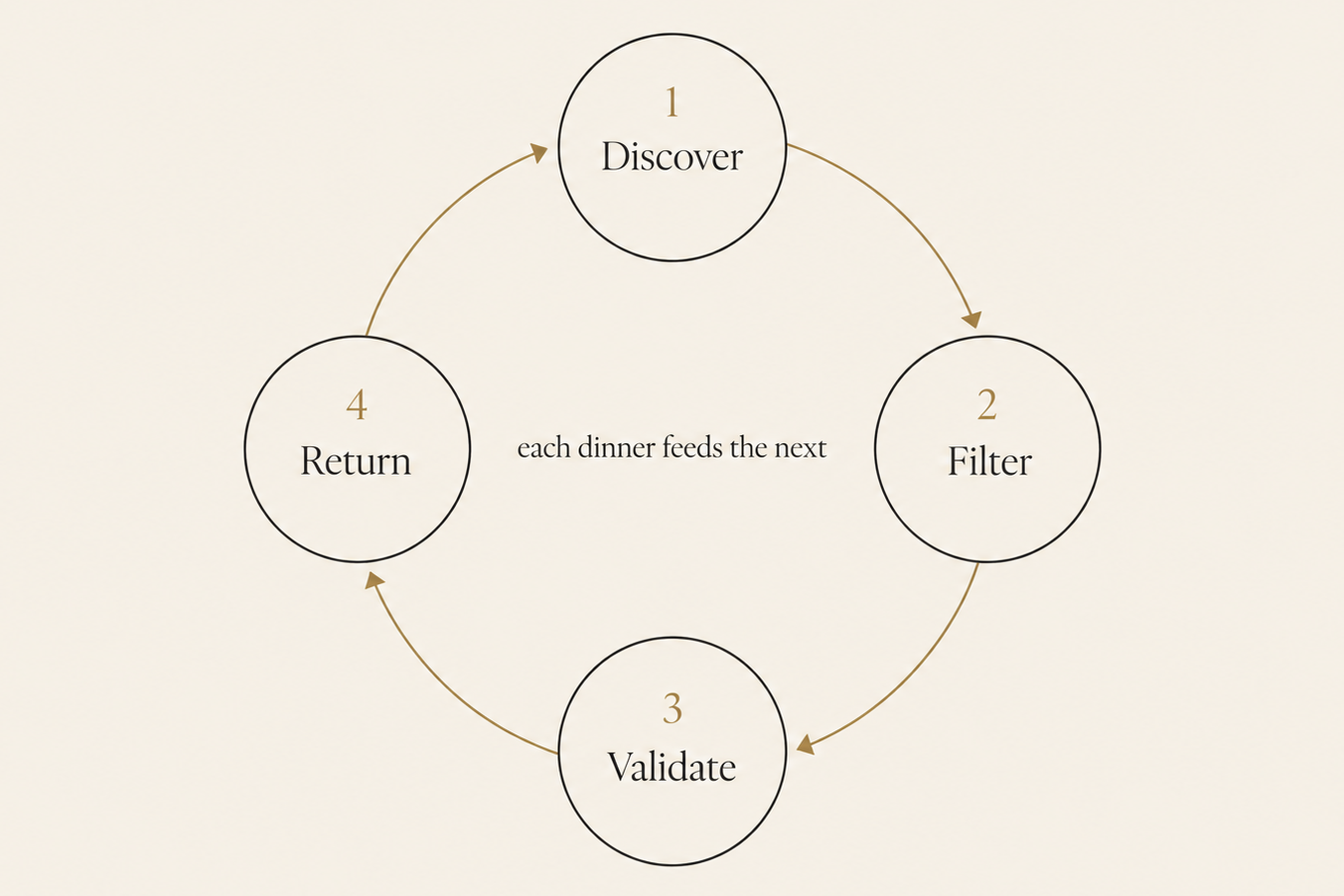
The four-stage dinner flywheel
Short answer
Use broad events to discover relevant people, small dinners to explore fit, and peer conversations to build trust. Give returning guests a reason to bring others, then measure each stage separately rather than assuming more events mean more revenue.
By Ed Giansante · Published
Most B2B teams ask whether more events means more pipeline. A better question is what each event feeds into the next. Small, private dinners work best as a system with four stages.
The short answer
Big events find the people. A small dinner qualifies them. Peers in the room persuade them. Alumni bring the next ones.
The point is not to host more dinners. It is to make each one do a different job, so the effort compounds instead of repeating.
Stage one: broad discovery
You meet leaders at major industry events and mixers. Treat these as listening posts. You are not collecting badge scans. You are reading the room to learn who is dealing with a serious operational problem right now.
The output of this stage is a short list of people with a specific, current problem, and a reason to invite each one.
Stage two: the intimate filter
Invite those specific leaders to a small, private dinner, typically 12 to 16 seats. Seat them with peers who have already solved that same bottleneck.
The room does the qualifying. Someone with a real problem leans in. Someone without one is easy to spot. This is cheaper and more honest than a discovery call booked from a cold sequence.
Stage three: peer validation nobody scripted
At the dinner, nobody sells. The host's job is to set the table well and stay out of the way.
This only works if the existing customer is there by choice and free to say what they think, good and bad. Do not script it.
Stage four: the alumni flywheel
Guests from early dinners come back. They invite their peers. Some change companies and bring your team in with them, sometimes within weeks of starting a new role.
Each dinner now starts from a warmer position than the last. That is where compounding comes from, and it is why the same number of events can produce more over time. Nothing about it is guaranteed. It depends on every earlier dinner being worth attending.
How to measure each stage
- Discovery: how many target leaders did you identify with a named problem?
- Filter: how many accepted, and how many peers with a relevant solved problem were seated beside them?
- Validation: how many follow-up conversations did guests start themselves?
- Return: how many guests came back, referred a peer, or reached out after a job change?
- Report pipeline influenced separately from revenue. They are not the same number.
Planning next year's budget
If you are setting a go-to-market budget, consider adding smaller, intimate activations beside your large-event spend. Pick a few accounts or a single problem area, run a small number of dinners, and track the four stages above before you scale.
Where does most of your go-to-market budget go today?